
A magic mushroom grow kit is a tub of substrate that the producer has inoculated with Psilocybe cubensis and left until the fungus has grown through all of it. That white network of threads is the mycelium. At home you only change its surroundings: more humidity, a little light, fresh air and steady warmth. Those signals make the mycelium switch from growing through food to forming mushrooms. Dutch-Smart gives one to three weeks from setting up a fully colonised kit to the first harvest, depending on temperature and humidity.
What is in the box
Kits differ per producer, but the ready-to-grow kits sold in Dutch smartshops follow the same pattern. The FreshMushrooms kit, for example, comes with a tub with a lid, a plastic bag with a micro-perforated filter strip and a paperclip, plus a printed guide.
| Part | What it is | What you do with it |
|---|---|---|
| Tub | substrate fully grown through with mycelium, sold as "100% mycelium" | take the lid off and keep it for later |
| Lid | closes the tub during transport | rinse it; you need it when you rehydrate the kit |
| Grow bag | clear plastic bag with a filter strip or micro-perforation | holds moisture around the tub while it lets some air through |
| Clip | paperclip or clothes peg | closes the folded top of the bag |
| Guide | the producer's instructions | follow it where it differs from general advice |
The number on the label, such as 1200cc or 2100cc, is the volume of the substrate block. A larger block holds more food and water, so it gives more per flush, but it does not grow faster.
From inoculation to the box on your doorstep
The work that takes longest happens before you buy the kit. A producer sterilises a nutritious substrate, inoculates it with spores or a liquid culture of a chosen cubensis strain and keeps it warm and closed until the mycelium has taken over the whole block. A well-known home version of this method is PF Tek, a recipe of brown rice flour, vermiculite and water that the grower Robert McPherson published online in the early 1990s. Commercial producers use their own recipes and rarely publish them.
Because the block is fully colonised, there is little bare substrate left for moulds and bacteria to settle on. That is why a ready-to-grow kit is far more forgiving than starting from a spore syringe, which requires sterile work for weeks before anything grows.
Fresh product. A colonised kit is alive and keeps developing. Dutch-Smart advises setting kits up as soon as they arrive; its 100% mycelium kits may be kept in the fridge for one day at most if you cannot start right away.
What switches the kit to fruiting
The mycelium fruits when conditions tell it that it has reached open air at the surface of its food. In a kit you imitate that with four things.
- Humidity. The bag keeps the air around the tub very moist. Dutch-Smart's growing guide aims for 80 to 95% relative humidity until the first mushrooms appear, then 85 to 90%.
- Light. Light is a signal for P. cubensis, it is not used as energy. In laboratory work, mushroom initials only formed in cultures that were illuminated; a fraction of a second of light was enough, and blue and near-UV light worked best while red and green light above 510 nm had no effect (Badham, 1980). Indirect daylight is enough.
- Fresh air. Mushrooms that grow in stale air, with a lot of carbon dioxide, form long thin stems with small caps. A filter strip and opening the bag briefly let in fresh air.
- Temperature. Producers recommend roughly 21 to 26 °C, depending on whose instructions you read. Below about 20 °C everything slows down; above 28 °C contaminants gain the upper hand.
The step-by-step grow guide turns these into daily actions.
Stages and timing
The table below is a typical timeline for a fully colonised kit at around 23 °C. Cooler rooms add days to every stage.
| Day | Stage | What you see |
|---|---|---|
| 0 | set-up | white tub in a closed bag, condensation on the inside of the plastic |
| 5 to 10 | pinning | tiny white or brown knots on the surface and along the edge of the tub |
| 7 to 14 | growth | pins stretch into mushrooms with caps and a pale veil underneath |
| 10 to 21 | harvest | the thin veil under the cap starts to tear |
| harvest + 12 h | rehydration | the tub is soaked in cold water and drained |
| after rehydration | next flush | the cycle starts again at pinning |
Most kits give two to four flushes, and the first is usually the largest, according to Dutch-Smart. After that the substrate is spent or contaminants take over, and the kit goes in the bin.
Why some kits fail
A kit on a cold windowsill can sit for weeks without pinning. A bag left wide open dries the surface, and pins shrivel. A heater or heat mat without a thermostat can push the tub past 28 °C, where the risk of mould rises. The contamination page shows how to tell bruising, which is harmless, from mould, which is not.
A typical first kit
A standard 1200cc kit of a common strain is the usual starting point. The larger XXL kit makes sense once you know your room's temperature and want more per flush. The kit and strain guide compares the options.
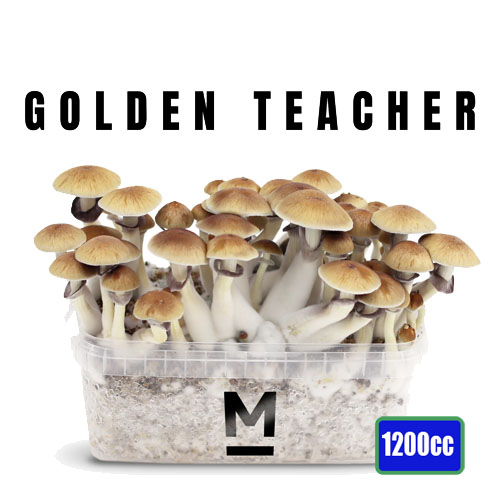 Golden Teacher - 1200cc Mushroom Grow Kit
€33.95Dutch-Smart
Stock ref DS-2776
Golden Teacher - 1200cc Mushroom Grow Kit
€33.95Dutch-Smart
Stock ref DS-2776
 Golden Teacher - FreshMushrooms Magic Mushroom Grow Kit
€39.50Dutch-Smart
Stock ref DS-2764
Golden Teacher - FreshMushrooms Magic Mushroom Grow Kit
€39.50Dutch-Smart
Stock ref DS-2764
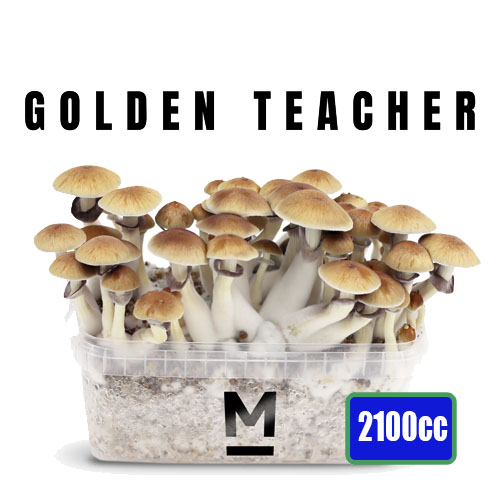 Golden Teacher XXL - 2100cc Mushroom Grow Kit
€49.95Dutch-Smart
Golden Teacher XXL - 2100cc Mushroom Grow Kit
€49.95Dutch-Smart
Prices include VAT and update automatically. Before you order, check the legal status where you live: in many countries the kit may be legal while the mushrooms it produces are not.